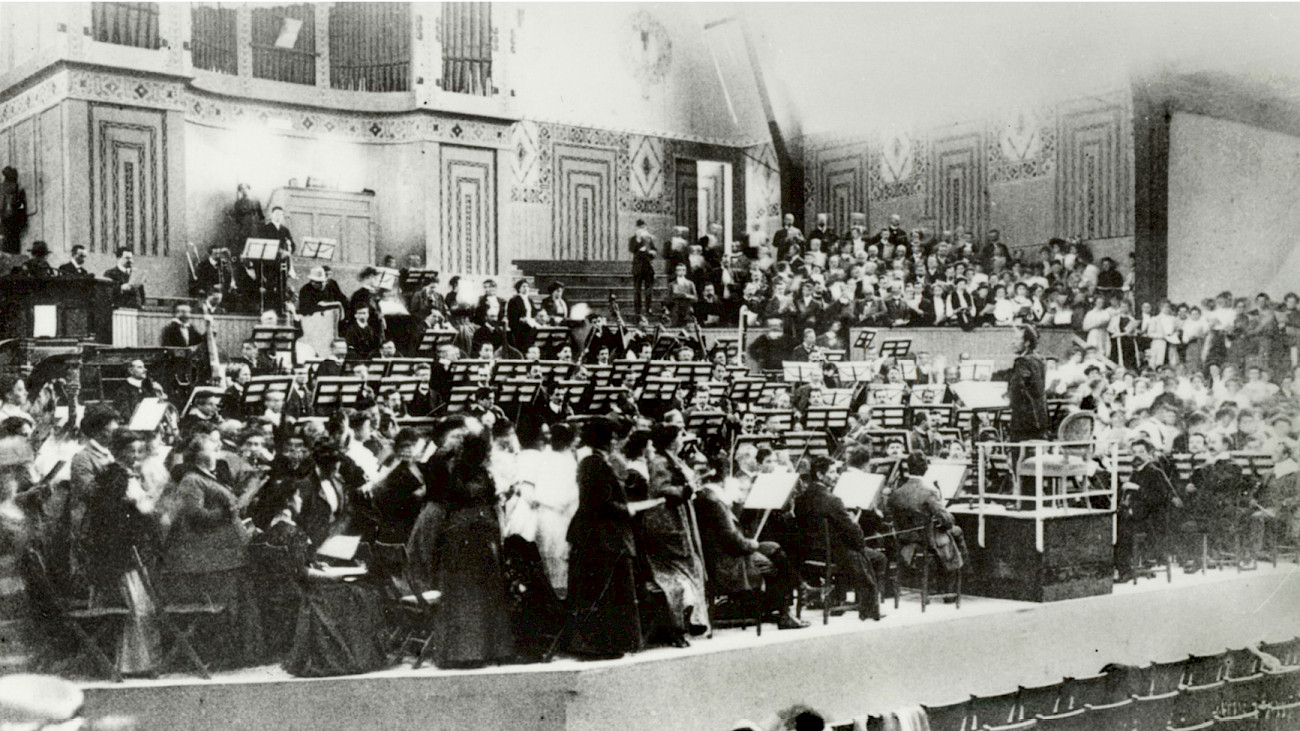
From 1891 to 1897, Mahler worked as First Kapellmeister at the Hamburg City Theatre, from 1897 to 1907 as First Kapellmeister and Director at the Court Opera in Vienna and from 1908 until his death in 1911 as conductor at the Metropolitan Opera in New York. He was considered the greatest opera conductor of his time and can probably be regarded as the first transcontinental conducting star. However, because of his perfectionism and impatience, he got into trouble at some point with all the orchestras he frequently conducted. Mahler could belittle the musicians to such an extent that tears were shed. But the artistic result of his concerts was excellent - and the audience was enthusiastic.
"A man of genius"
Mahler brought a wealth of exciting works to the stage as part of his engagements. in 1892, for example, he conducted the German premiere of Tchaikovsky's "Eugene Onegin", standing in at short notice for the overly nervous composer. The composer was grateful and wrote to his nephew: "The conductor here is not an average man, but a man of genius who will give his life to conduct the first performance."
In the same year, Mahler conducted Wagner's "Ring" in London. Here, too, he enjoyed great success. He confidently reported to a friend: "I was the best again!" The reaction to the first London performance of "Fidelio" in German shortly afterwards (the opera had previously only been performed in Italian) makes it clear where Mahler's attitude came from: "'Fidelio' was fiercely attacked and fought against by half the critics here. But the audience gave me absolution for my blasphemy with a veritable orc of applause. [...] In fact, I have to go to the ramp after every act - the whole house shouts 'Mahler' - until I appear."
"Like an elementary catastrophe"
His goal was to become director of the Vienna Court Opera. But despite his reputation and abilities, it wasn't to work out at first: "As things stand in the world now, my Jewishness prevents me from entering any court theatre." Mahler therefore converted to Catholicism. He made history with his work in Vienna: through a reform, he changed musical theatre practice forever - and made the Vienna Opera the best stage in the world at the time, despite all anti-Semitic hostility.
With the support of stage designer Alfred Roller, Mahler introduced innovations aimed at unifying staging, decoration and musical performance. From then on, latecomers were no longer allowed into the hall and the auditorium was darkened. Mahler intensified the rehearsals and trained the singers to act like actors. The cellist of the court opera orchestra and later composer Franz Schmidt noted: "His direction descended on the opera theatre like an elemental catastrophe [...]. Anything that was old, outdated or not quite viable had to fall away and perish without a hope of salvation." Mahler was of the opinion: "What you theatre people call your tradition is your convenience and sloppiness." Even if some supporters of the old style of theatre turned their backs on the Viennese stage as a result, the idea worked. Mahler dusted off the house, as this statement by conductor Bruno Walter makes clear: "He freed Mozart from the lie of daintiness, as well as from the boredom of academic dryness, gave him his dramatic seriousness, his truthfulness [...]. Through his actions, he transformed the audience's previously lifeless respect for Mozart's operas into an enthusiasm that shook the house with its demonstrations."
During his time in New York (where he had lost a little of his strength), he also won over audiences. After a "Tristan" performance in 1909, a review in the "Sun" newspaper said that Mahler had unleashed a vital stream of sound "such as we have never heard before".
"Like a blazing flame"
The reviews make it clear that Mahler can obviously be regarded as an exceptional talent. In a letter, he revealed what his goal was: "I consider it my greatest achievement that I force the musicians to play exactly what is written in the notes." How did he achieve this? If we are to believe contemporary observations, his conducting style differed markedly from the static and calm style of his colleagues: The Viennese music critic Max Graf described Mahler as "always on the move, like a blazing flame" - and always jumping up from his conductor's chair as if he had been stabbed.
Mahler broke with old traditions. After he took up his post in Vienna, the critic and writer Ludwig Speidel noted: "Mr Mahler is a small, slender, energetic figure with sharp, intelligent features [...]. He belongs to the younger school of conductors who, in contrast to the statuesque demeanour of the older conductors, have developed more lively facial expressions. These younger conductors speak with their arms and hands, with turns of the whole body when necessary; the dry wood of the baton flaps between their fingers and turns green."
His movements are depicted particularly impressively in contemporary caricatures. Here we see a Mahler stretching upwards - probably also due to his height of just 1.63 metres - or swinging the baton with wild gestures. However, such contemporary testimonies should be treated with caution: Perceptions of Mahler were characterised by anti-Semitic stereotypes, so they could be projections motivated by hostility towards Jews. Mahler struggled with anti-Semitism throughout his life. Nevertheless, he went on to have an incredible conducting career - and even more: he became one of the first international stars on the conductor's podium.