Count Wallstein didn't let himself get carried away: when a Swiss dairyman rescued him after a mountain accident, he wanted to offer him a carefree life in return and built a Swiss idyll on his German estate - including a mountain hut, flowerbed and Alpine panorama. An abstruse story, admittedly, but it made Joseph Weigl's singspiel "The Swiss Family", which premiered in 1809 at the Kärntnertor theatre in Vienna, a hit. Schubert loved the work, Wagner conducted it, and for decades it was part of the core repertoire of European theatres. And it undoubtedly fuelled the Romantic enthusiasm for Switzerland.
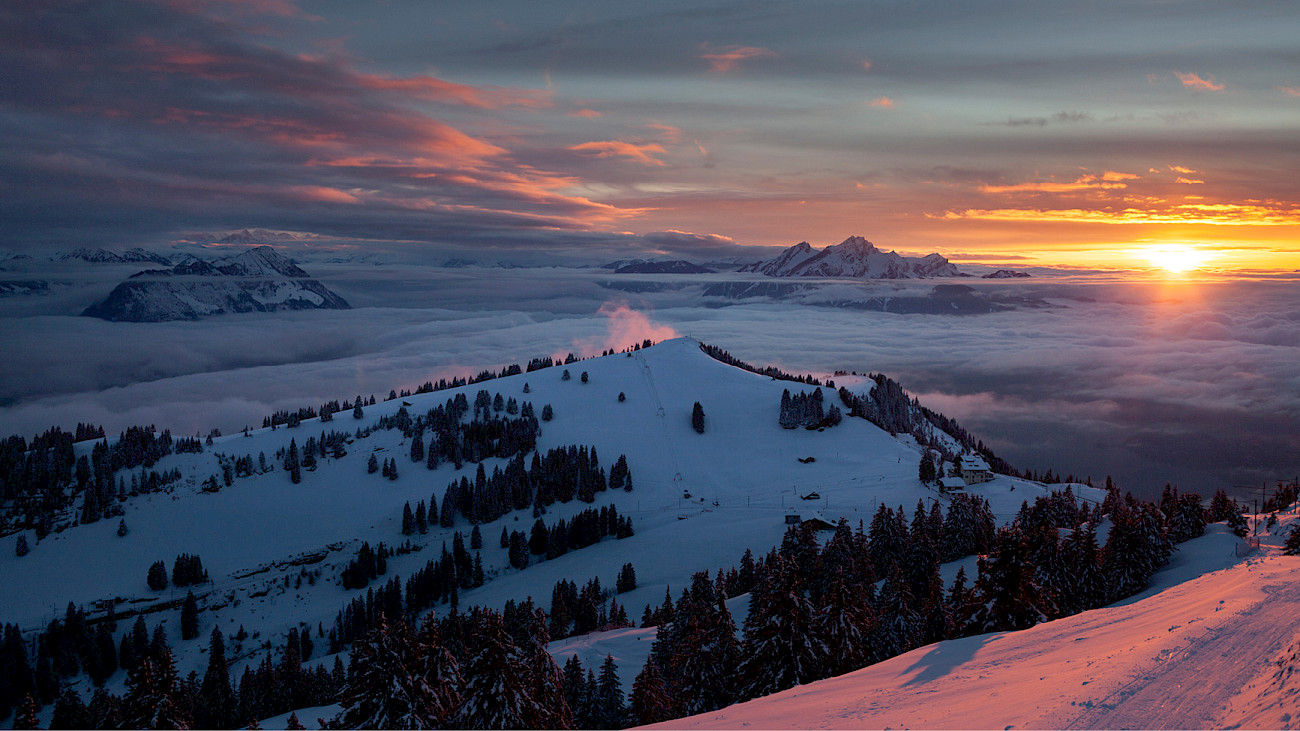
This enthusiasm can also be seen in later works: Liszt's piano pieces from the "Années de pèlerinage", for example, which are characterised by Swiss impressions, or Rossini's last opera "Guillaume Tell", for which he intensively explored the form of the herd of cows. The "Swiss Psalm" by the Uri priest Alberich Zwyssig, composed in 1841, which has provisionally served as the Swiss national anthem since 1961 and definitively since 1981, also belongs in this series: the Alpine firn reddens, and many other images of nature, from the evening glow to the sea of clouds to the wild storm, not only praise the local landscape, but also give the "pious soul" a sense of where God is at work.
Grumpiness instead of rapture
Recently, however, this God has been in a bad mood - not in the Alps, but just before them, between Steffisburg and Thun. The snow on the roadside is dirty, the sky and lake are grey-blue in the song "Stäffisburg" by Bernese band Patent Ochsner, released in 2024. There are no sublime feelings, on the contrary. "Mir si iiklemmt hie", goes the chorus, and also: "Dr Liebgott het e schlächte Luun."
There is no doubt that this is a different Switzerland than in the 19th century. A narrower, more ordinary, duller one. This is not only because the world has changed and a certain grumpiness is more in keeping with the spirit of the times than hymn-like rapture. It also has to do with the fact that the once so attractive nature metaphors have long since congealed into clichés: They have been heard too often in pop songs at the edge of the piste or in mountain restaurants stormed by mass tourism. Even in the "Swiss Psalm", they now sound so wrong to many that rewordings are constantly being suggested.
A new, kitsch-free view of the homeland was therefore called for, and this has not only been provided by Patent Ochsner for several decades: Time and again, sound tinkerers have climbed into the glaciers to extract special sounds from the ice. In Biel, composer Fabian Müller and writer Tim Krohn premiered the opera "Eiger" in 2021, in which a historically documented mountain accident does not end in a mild way, as in Weigl's Count Wallstein, but with four fatalities. And then there are also numerous folk music formations that set themselves apart from the clichés with their rugged originality or cosmopolitan multi-stylistics.
Speaking of cosmopolitanism: the band Züri West comes to mind, who were already dreaming away from a Switzerland where the moon hangs like a cheese between the clouds in "Bümpliz - Casablanca" back in 1989. The protagonists of the song actually almost left, they were "druff u dranne". And stayed in the end.