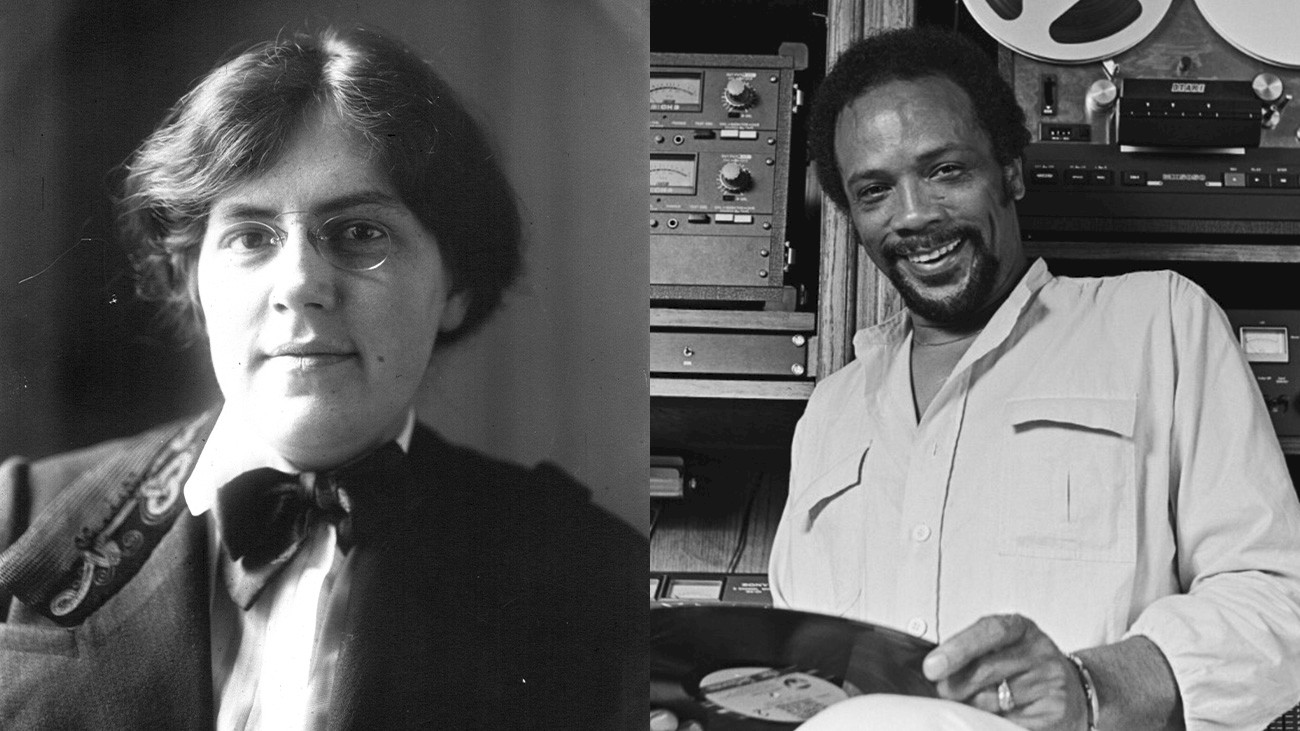
Their nicknames alone show what different worlds they were travelling in. At first glance, Nadia Boulanger and Quincy Jones appear to be a very unequal pair of teacher and pupil. But it is not without reason that Boulanger, this unassuming lady of Russian and French origin, was labelled the "teacher of the century". The list of her pupils, including Leonard Bernstein, Aaron Copland, Astor Piazzolla, Philip Glass and Sir John Eliot Gardiner, reads like a musical hall of fame of the 20th century. Although she was rooted in classical music, she also taught numerous jazz and pop greats, such as the bandleader, film music composer and producer of the century Quincy Jones, known as "Q", in the late 1950s, who released Michael Jackson's "Thriller", the best-selling album in pop history with over 65 million copies.
He was 24 years old when he started taking lessons from the then 70-year-old teacher in her Paris flat. In the first lesson, she gave the new pupil a simple piece of advice: "There are only twelve notes, Quincy, really only twelve. Just have a look at what others have done with them." At this point, Jones was no longer a beginner. At the age of 18, he was already playing trumpet in the Lionel Hampton Big Band and arranging pieces by Louis Armstrong, Dizzy Gillespie and other great jazz musicians.
Nevertheless, he is said to have said in old age that he owed everything he had achieved as an artist to his early training with Boulanger. Her teaching style was unique: she taught thorough academic musical analysis and knew how to encourage her students to find their own distinctive musical language. The then grey-haired little "Mademoiselle" could also speak plainly, as Jones later recalled: "She always told me: 'Quincy, your music can never be more or less than you are as a person. If you have no life experience and nothing to say about what you have experienced yourself, you have nothing to contribute at all ...' She was strong. Really strong."