What kind of connection do you have with Simon, Sabine?
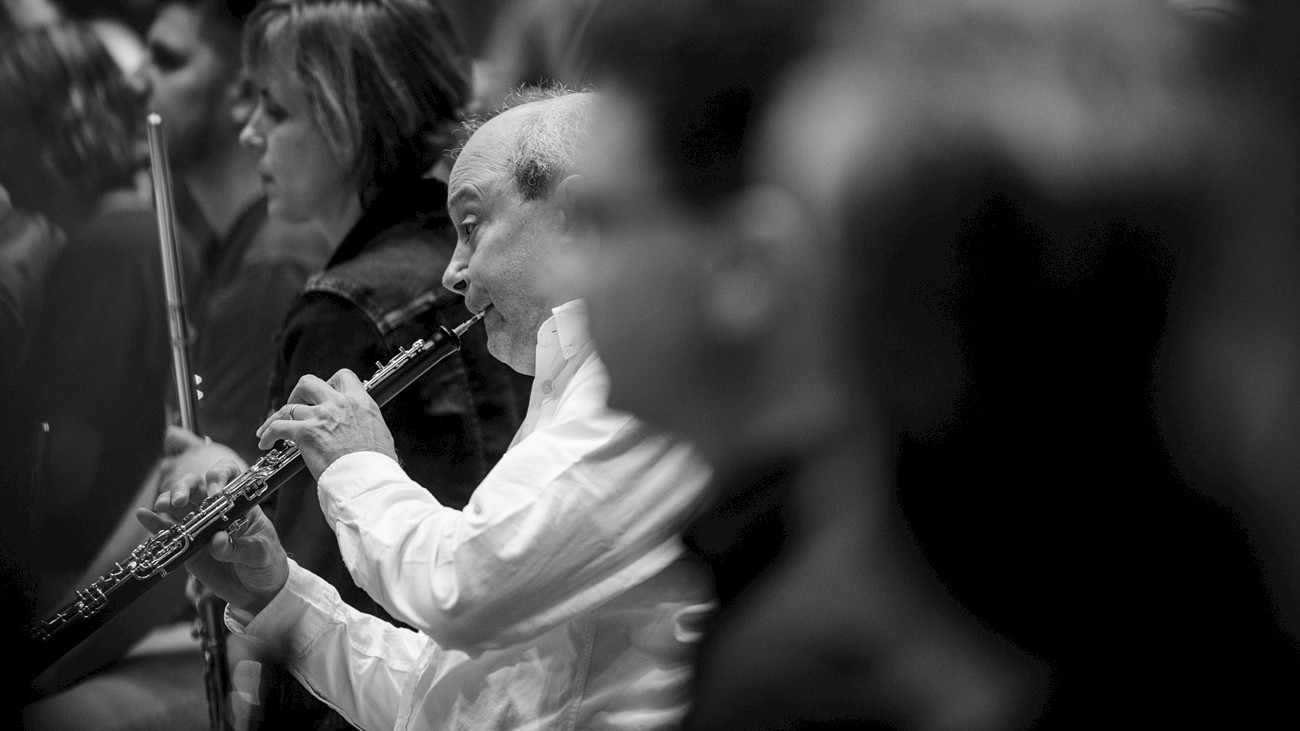
He has not only become a very, very valued colleague, but also a friend. And of course he's an incredibly good musician. Everyone who has ever had anything to do with him knows that. It's incredibly impressive how he maintained such an extremely high level as an outstanding oboist until the end of his career. It is very, very rare to meet a musician with so much depth and heart. He really serves the music, never puts on a show. Musically, he strikes just the right balance between creativity and great respect for the compositions. He also has a kind of modesty that I really admire. And as a person, he was always there for me, in the good and bad moments, always supportive on and off stage.
What characterises him as a musician and as a person, Matthias?
He's not just anyone. He has been one of the cornerstones of the orchestra, combining many traditions: as someone who joined the orchestra at a very young age; someone who has greatly enriched musical life in Zurich and Switzerland; and someone who, even as a young musician, made a conscious decision in favour of an orchestral career and a teaching career, although he was also a much sought-after soloist. There are many good oboists, but to really deliver at the highest level for 36 years is amazing. He would still cut a really good figure in an audition today and would make it difficult for anyone to get the job against him. As a musician, you have a lot of respect for that. And he really characterised the woodwind section of the Tonhalle Orchestra Zurich - through his presence, without being intrusive, without lecturing. I remember when I joined the orchestra, he was one of those people I trusted. I knew immediately that he meant well by me. Of course, he was also a great role model musically. When he phrased something, I knew: I just had to go with him. That was something special.
Sabine, do you remember the first time you met him?
That was at my audition. It was a bit special because there was a final round in the orchestra at the time and it was also a recording production. Simon played Richard Strauss' oboe concerto. That was the first time I had heard him. And I was very impressed. But above all, it was crazy that it worked immediately with us playing together. It should stay that way. There were always moments in the concert where we had a spontaneous impulse or idea together. We were amazed that something like that could happen without consultation. And we often laughed when we discovered funny things or situations at the same time.
Is there anything that is typical of him, Matthias?
His attitude to his job. He was always there early, always tinkering with the pipes. He always got in early, even going back on stage during a break. You could see from the outside that he was highly professional and had the right attitude, with the right consistency. The love with which he continued to research the reed, the wood - he was an oboist with complete dedication, with all his soul.
He then also reduced many things around it. Because his focus was always on being really fit for orchestral duties. That's not a matter of course - it could have been different. But Simon had extremely high expectations of himself.
Is there anything you can take away from him, Sabine?
Yes, a lot of things. He had a sound that conveyed emotions - through his sound alone. It wasn't just his timing and phrasing, but also his tone. Very, very warm. Oboe can sound very direct if it is played with too much nose. That was never the case with him. Even when he played loudly, the tone remained round. He could also produce a lot of different colours, for which other people have to change reeds. Simon could play very delicately and fragile one moment and two seconds later very full and generous.
But there is something else that I "take away" from him. It's something very personal: 20 years ago, he helped us a lot with our flat. Without Simon, we wouldn't be living there today. That changed our lives back then and we are still very happy today.
What special moments do you associate with him?
Matthias: It was always special with Simon because we had the same taste in many things, shared the same opinion and analysed situations in the same way. That's why I asked him 10 years ago if we wanted to record Vivaldi together. We then divided up the six concertos: He played three, I played three and then we recorded the double concerto together. That's a wonderful memory that will stay with us - and it was also an expression of our common bond.
Sabine: He is a very sensitive musician who often moved me to tears. Sometimes it was even difficult to continue playing because I was so moved. And he was also very moved himself. I'm thinking of Mahler's "Lied von der Erde", for example. This honesty and this love of music. We could feel that he gave so much of himself to the music. He always gave everything. His whole heart. And just thinking about it, I'm so touched and so sad that he's leaving. They say that everyone can be replaced, but with him goes a unique musician.